




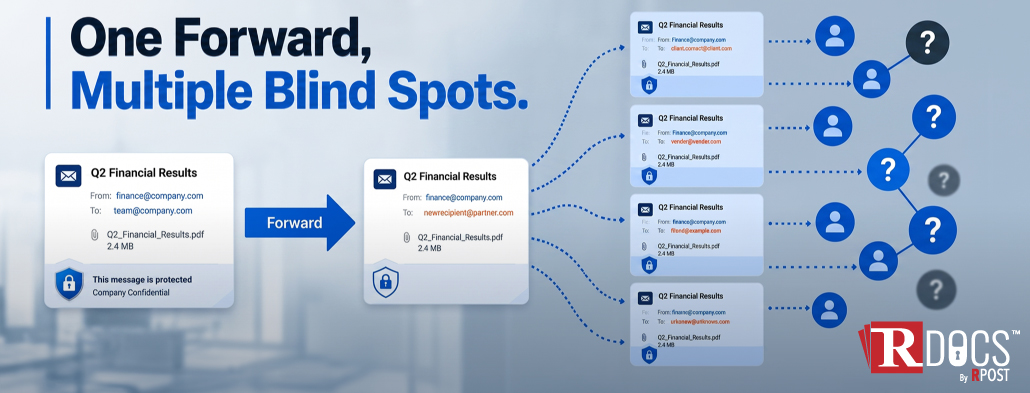
That is increasingly how sensitive information leaves organizations today.
Not through ransomware. Not through advanced intrusion techniques. Not through zero-day exploits. In many cases, exposure happens through an ordinary business action that barely registers as a security event: someone forwards a file.
A legal document gets shared outside the approved group. A financial spreadsheet is sent to a personal email for convenience. A healthcare record is forwarded to an external consultant. A board presentation reaches a third party who was never intended to receive it.
The transmission itself may have been secure. The recipient may even have been legitimate at the time. But once the file moves beyond the original audience, visibility often disappears.
This is why forwarding is becoming a modern form of data breach.
Most organizations still think about document security primarily in terms of transmission. Was the email encrypted? Was the portal secure? Was the connection authenticated?
Those protections matter. But they mostly secure the route the document travels through, not the document itself after delivery.
The problem starts once the file arrives.
Modern workflows depend on constant document movement between internal teams, clients, vendors, advisors, regulators, and outside counsel. Files routinely travel across platforms, inboxes, personal devices, cloud drives, and collaboration tools.
Every forward creates another copy. Another access point. Another uncontrolled environment.
And in many cases, security teams have little or no visibility into what happens next.
A forwarded document may end up:
The organization that originally created the document often has no reliable way to track this movement afterward.
Forwarding is dangerous because it does not look dangerous.
There is no obvious malicious activity. No malware alert. No brute-force login attempt. No suspicious executable. From a user perspective, it may look like routine collaboration.
That is exactly why it creates risk.
In high-stakes industries like finance, legal services, and healthcare, documents themselves contain the valuable information attackers or unauthorized parties want:
The file becomes the asset.
And once that asset is forwarded outside the intended boundary, the organization may lose:
This is the post-delivery security gap many enterprises are still struggling to address.
Traditional security tools are designed around protecting infrastructure, endpoints, and transmission channels. They are less effective once a document has already reached a recipient.
Email security platforms can help filter malicious messages and reduce phishing risk. Encryption protects data during transmission. Data loss prevention tools may flag suspicious outbound activity.
But these controls often weaken once the file has already been delivered and opened.
For example:
At that stage, the original sender may no longer control the document’s lifecycle.
This is one reason why enterprise digital rights management and document-centric security models are receiving renewed attention. Organizations are starting to realize that protecting the path is not enough if the document itself becomes uncontrollable afterward.
One of the biggest operational issues is the lack of audit visibility after forwarding occurs.
Many organizations cannot confidently answer:
That uncertainty becomes especially risky during litigation, regulatory reviews, mergers, financial negotiations, or privacy investigations.
The core issue is not sending documents. Businesses must share information to operate.
The real issue is what happens after sharing.
That is why many security leaders are shifting toward document access control models that continue functioning after delivery. Instead of treating a file as permanently uncontrolled once sent, organizations are looking for ways to maintain visibility and governance throughout the document lifecycle.
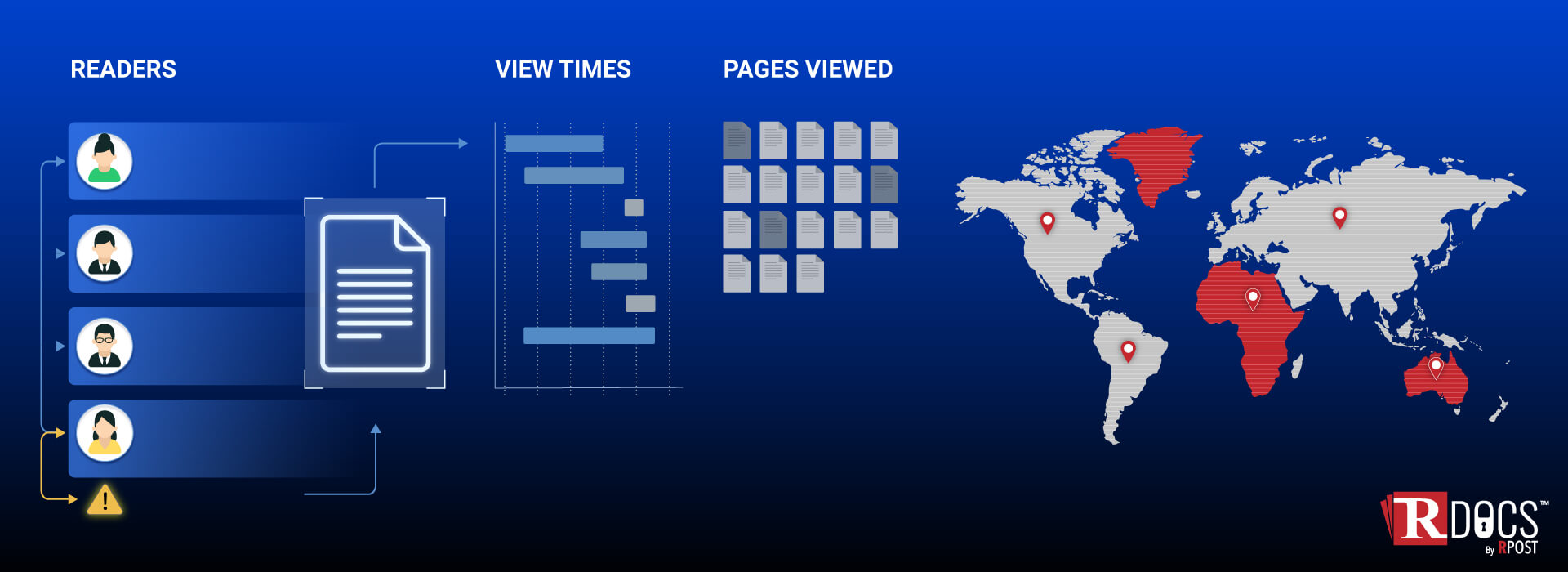
This includes capabilities such as:
The goal is not to stop collaboration. It is to reduce uncontrolled exposure.
Document-centric security starts from a different assumption: the document itself should carry persistent protections.
Instead of depending entirely on the storage platform, inbox, or network perimeter, the document remains governed wherever it travels.
This approach aligns closely with enterprise digital rights management principles, but modern implementations increasingly focus on usability alongside security. Complex recipient onboarding and login friction often reduce adoption, especially in external collaboration environments.
Organizations need controls that work within real business workflows, not against them.
RDocs® addresses this challenge by focusing on post-delivery document control rather than only transmission security.
Its approach is built around the idea that sensitive files should remain governable after leaving the sender’s environment. Through its RPD technology, RDocs® enables organizations to track document activity, restrict viewing conditions, and revoke or “kill” access when necessary.
For security and compliance teams, this changes the operating model. Instead of assuming that forwarding permanently ends control, organizations can maintain stronger visibility into how documents are accessed and shared over time.
Forwarding is now one of the simplest ways sensitive information escapes organizational control.
No malware. No breach toolkit. No sophisticated exploit chain.
Just one forward.
As business collaboration becomes more distributed, organizations need to rethink where document security actually begins and ends. Securing the transmission is still important, but it is no longer enough.
The document itself must remain controllable after delivery.
That is the shift behind document-centric security and post-delivery governance models like RDocs.

September 01, 2026
August 13, 2026
July 10, 2026
July 03, 2026

June 26, 2026



 Blog
Blog