





There's a widely held assumption in enterprise security: once a document has been transmitted securely — encrypted in transit, delivered to the right address — the organization's accountability for that document has been fulfilled.
That assumption is dangerously wrong. And in regulated industries, finding out the hard way usually comes with a massive price tag.
Compliance frameworks governing sensitive information in finance, healthcare, and legal services do not distinguish between data that lives inside your network and data you've shared externally. The obligation follows the data. A patient summary sent to a contracted research partner is still governed by HIPAA minimum-use standards wherever it ends up. A financial disclosure distributed to an auditor remains subject to GLBA confidentiality requirements regardless of which inbox it lands in. Personal data in a contract shared with outside counsel is still governed by GDPR obligations after it leaves your environment.
The question, then, is not just whether your documents are secure when you send them. It's whether you can prove accountability for what happened to them after.
Most security teams think about compliance in terms of what happens inside their environment — access controls, encryption standards, audit logs for internal systems. These are necessary. They are not sufficient.
GDPR's accountability principle requires that organizations be able to demonstrate compliance with data protection obligations — not simply assert it. That includes demonstrating how personal data in documents was handled after external distribution.
HIPAA's minimum necessary standard requires covered entities and their business associates to limit disclosure of protected health information to what is needed for a specific purpose. That obligation doesn't evaporate once the document has been transmitted to a business associate. If a document containing PHI is later accessed by an unauthorized party in the recipient's environment, the question of whether the sender maintained appropriate controls becomes part of the breach investigation.
GLBA's Safeguards Rule requires financial institutions to implement administrative, technical, and physical safeguards for customer information — a standard that extends to information shared with third parties. The regulation explicitly includes oversight of service providers who receive customer data.
In each framework, the accountability obligation extends beyond the point of transmission.
Encryption in transit is not document governance. It establishes that the document was protected while moving from your server to the recipient's. It says nothing about who accessed it after delivery, whether it was forwarded to parties outside the intended scope, or whether access was revoked when the purpose of the disclosure was fulfilled.
When a regulator investigates a data incident, they are not primarily interested in your transmission logs. They want to know what happened to the data — who accessed it, when, under what authorization, and what controls were in place to limit exposure. A delivery receipt cannot answer those questions. Neither can a DLP dashboard that only sees data in transit within your own environment.
The compliance gap isn't a perimeter problem. It's the simple fact that you have no way to answer those questions once a document belongs to someone else's inbox.
Regulatory investigations and audits increasingly focus on data lifecycle governance — not just whether data was protected at a point in time, but whether controls were maintained throughout its useful life. For documents distributed externally, that means being able to account for the full access history: who opened it, when, from where, and whether any access fell outside authorized parameters.
Most organizations, if asked to produce this record for a document shared externally six months ago, have nothing to show beyond the original transmission record. They can confirm the document was sent. They cannot confirm who read it, whether it was forwarded, or whether it was still accessible after the need for disclosure had passed.
That gap is a governance failure, regardless of whether it resulted in a breach.
There's an important distinction between proof of delivery and evidence of governance. Delivery confirmation — whether through email read receipts, registered email services, or transmission logs — establishes that a document reached its destination. It does not establish that access was limited to authorized parties, or that unauthorized access was detected and responded to.
Regulators making accountability assessments under GDPR, HIPAA, or equivalent frameworks are asking the second question, not the first.
Under GDPR's accountability principle (Article 5(2)), a supervisory authority can require an organization to demonstrate — not simply assert — that personal data shared externally was handled in accordance with the regulation's core obligations. That means being able to show that access was restricted to the stated purpose of the disclosure, that the document did not reach parties outside the intended scope, and that technical controls were in place to enforce those boundaries after transmission. A delivery log satisfies none of those requirements.
HIPAA's minimum necessary standard carries an equivalent expectation. When the HHS Office for Civil Rights investigates a disclosure of protected health information, it asks whether the covered entity implemented policies and procedures limiting PHI to only what was necessary for the stated purpose — and whether access logs exist to confirm that those limits were actually enforced. A business associate agreement establishes the contractual obligation. It does not, by itself, produce the evidence that the obligation was met.
In both frameworks, the accountability question is the same: can you demonstrate what happened to this data after it left your environment? Transmission records answer where the document went. Governance evidence answers what happened to it once it got there. For most organizations sharing sensitive documents externally, that second question has no answer — not because controls were violated, but because no mechanism existed to capture the record in the first place.
The architectural solution is simple enough to state, even if the execution is complex: those internal governance pillars—access restrictions, audit trails, and the ability to revoke permissions—must extend to files that have already cleared your perimeter.
This requires a different technical model than what most organizations currently deploy. Perimeter-based security tools, DLP systems, and centralized data rooms all share a common dependency: they operate on infrastructure the originating organization controls. The moment a document is transmitted externally, those controls become unavailable.
File-embedded security — where access controls and audit mechanisms are encoded into the document itself — removes that dependency. The document carries its own governance regardless of where it travels or whose device it lands on.
RDocs™ by RPost converts documents into RPD™ (Rights Protected Document) files that maintain access controls and generate a complete audit record independent of any centralized server or recipient-side infrastructure. Recipients open the file in any browser with no software installation or account creation required — removing the adoption friction that historically made enterprise DRM impractical for external distribution.
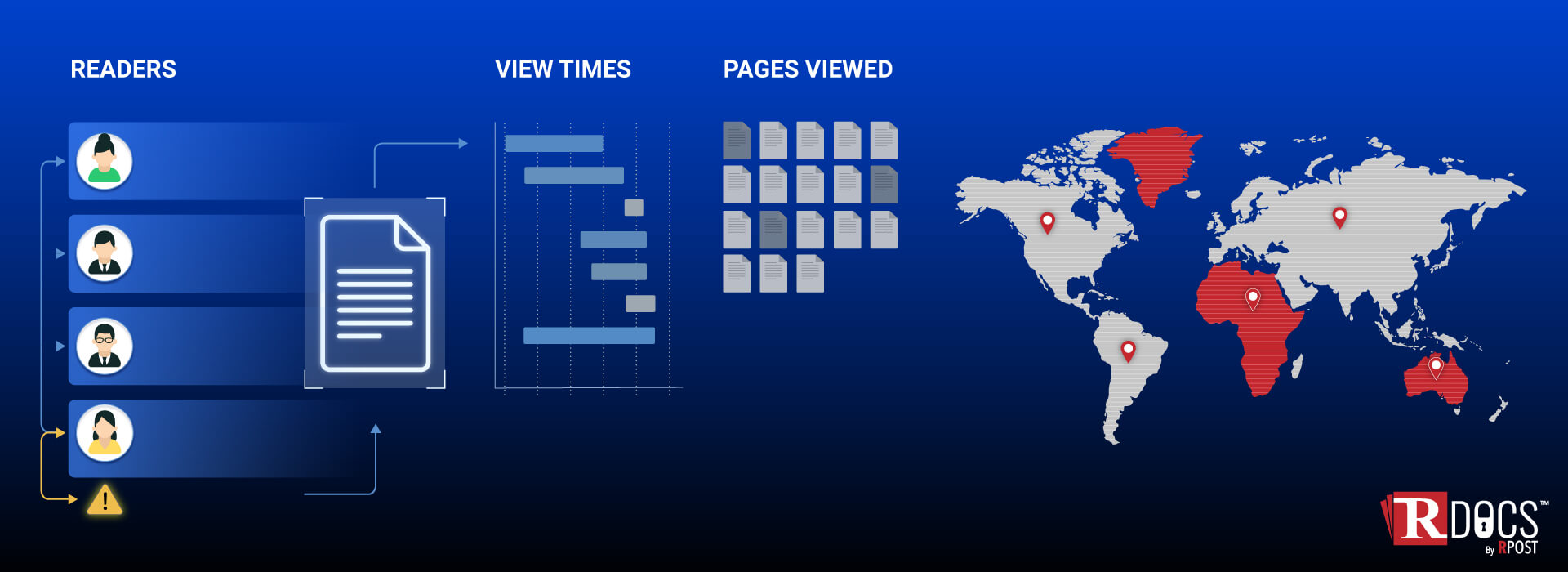
From a compliance governance standpoint, what RDocs™ creates is a continuous chain of accountability: every access event is timestamped, geolocated, and logged against a verified reader identity. If a document needs to be retracted — because its purpose was fulfilled, because the recipient relationship ended, or because it was distributed in error — the originator can kill access across all existing copies with a single action, even copies already downloaded to a recipient's device.
For businesses bound by GDPR's accountability principle, HIPAA's breach obligations, or GLBA's safeguard rules, this fundamentally transforms external document sharing from an unmonitored liability into an auditable, defensible record
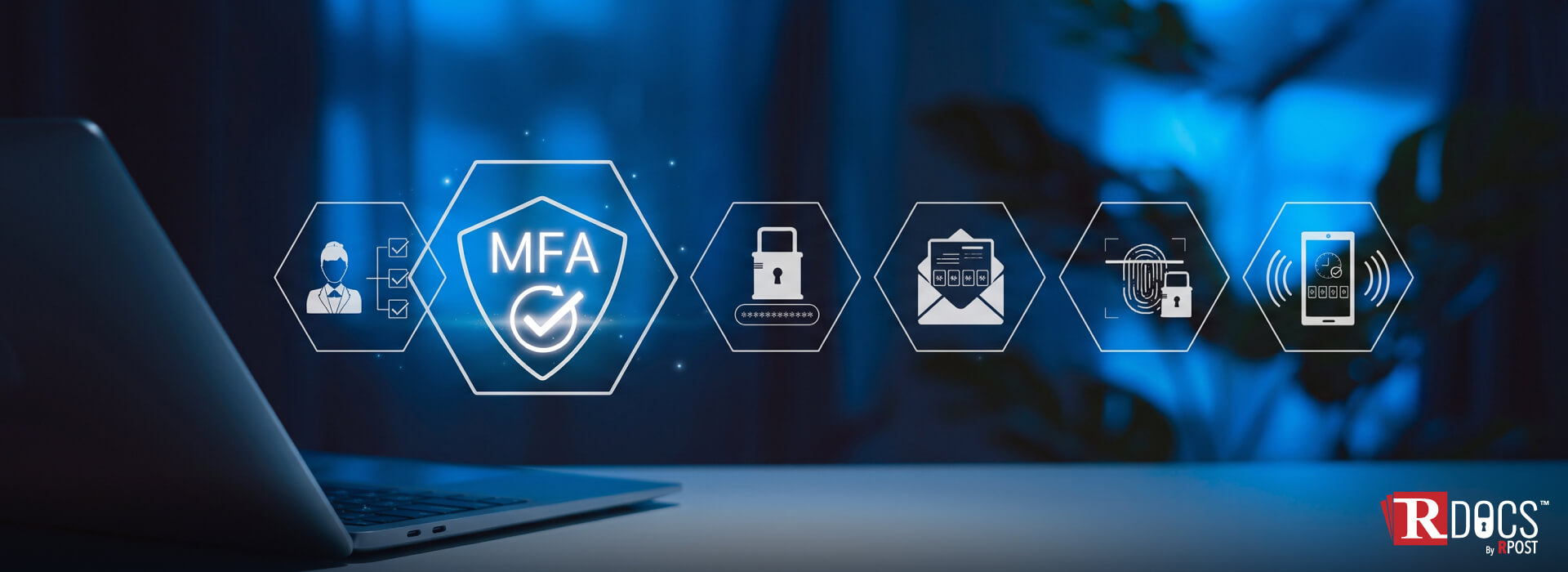
The controls operate at three levels of sensitivity — from transparent tracking of all access events through to stringent restriction of distribution to pre-verified readers with two-factor identity verification — allowing organizations to calibrate governance to the sensitivity of the content..
Move past from the defensive transmission practices and establish true, demonstrable governance over sensitive information throughout its entire lifecycle with RDocs™.
October 13, 2026

September 01, 2026
August 13, 2026
July 10, 2026

July 03, 2026



 Blog
Blog