





A sensitive document leaves your organization. It reaches the intended recipient. Transmission confirmed, delivery logged.
What happens next is outside your visibility entirely.
Most enterprise security teams have no mechanism to know if that document was opened from the recipient's office network in London — or from a data center in a geography they have never done business with. Both events look identical in a delivery log. Neither triggers an alert. Neither prompts a response.
That blind spot is not a gap in your firewall. It is a gap in how document security has traditionally been architected — and in regulated industries where sensitive IP, clinical data, and deal documents travel constantly to external parties, it is where some of the most damaging exposures begin.
When a document is accessed from an unexpected location, geography alone is not the threat indicator. What matters is the behavioral deviation it represents.
An authorized recipient in Frankfurt opening a document from their usual office IP at 9 AM is baseline behavior. That same document opening from a residential broadband address in a different continent at 2 AM is a deviation from that baseline. Combined with factors like an unrecognized device fingerprint, an IP range associated with hosting infrastructure rather than a corporate network, or access velocity inconsistent with a single reader — location becomes part of a behavioral fingerprint that signals something worth investigating immediately.
Security teams in legal, finance, and pharmaceutical organizations work with documents that carry material risk if accessed by unauthorized parties: pre-publication clinical protocols, M&A term sheets, litigation strategy, client financial records. For these document categories, the window between anomalous access and material harm is not measured in days. It is measured in minutes. A detection system that surfaces an anomaly in a weekly audit report is not a security control. It is a forensics tool.
The distinction matters. Forensics tells you what happened. Security prevents what is about to happen.
Geographic access controls at the network level are well-established. Organizations define IP allowlists, restrict VPN access to approved regions, and enforce routing rules on their own infrastructure. These controls are effective — for systems they manage.
The moment a document crosses into external distribution, network geofencing ceases to function. The file is now on a device the organization does not manage, traversing networks it does not control, potentially opened in environments with entirely different security postures. The geographic boundaries enforced at the perimeter have no bearing on who opens that attachment next.
Document-level geofencing solves this at the file layer, not the network layer
The access policy travels inside the document itself containing essential access controls that are embedded in the file at the point of distribution — and they remain active regardless of where the file subsequently lives, who it was forwarded to, or what network it is opened from.
This is architecturally different from anything a network security tool can provide. It is also the only mechanism that remains effective after the document has left the organization's environment.
There are two fundamentally different things a document security system can do when it detects access from an unexpected location.
The first is to log it. If a breach is later confirmed, the log has forensic value. For low-sensitivity documents in low-risk contexts, this may be sufficient.
The second is to respond to it — automatically, without waiting for human review.
For the document categories that CISOs and Data Privacy Officers in regulated industries are actually responsible for, logging alone is inadequate. An automated response layer needs to evaluate the access event against expected parameters in real time and act: locking the document, alerting the originator, and requiring explicit human authorization before access is restored. The document does not continue to be readable while the security team investigates. It becomes inaccessible the moment the system detects the deviation.
This is the detection-to-intervention pipeline. And building it requires controls that live inside the document — not on the network the document passes through.
Active intervention at anomaly detection is the response layer. The more complete security architecture also includes a preventive layer: configuring access boundaries at distribution so that predictable categories of unauthorized access are blocked before they can occur.
Preventive geofencing and anomaly detection are not competing approaches. They address different threat scenarios. Geofencing handles the predictable cases — unauthorized domains, unauthorized geographies, unauthorized network ranges. Anomaly detection handles the cases the predefined boundaries didn't anticipate: a legitimate recipient whose device has been compromised, a credential that has been stolen, an access pattern that has silently changed from the established baseline.
Together, they close the post-delivery visibility gap that network security tools cannot reach.
RDocs™ by RPost converts documents into RPD™ (Rights Protected Document) files — a format that embeds access controls inside the file itself, with no dependency on centralized storage, no software requirement for the recipient, and no login friction. Recipients open RPD files in any browser on any device, identically to a PDF. The security operates entirely on the sender's side.
At the preventive layer, RDocs™ provides configurable geofencing mechanisms that binds the document to defined network ranges. All these are configurable per document at the point of conversion and remain active after delivery, after download, and after forwarding.
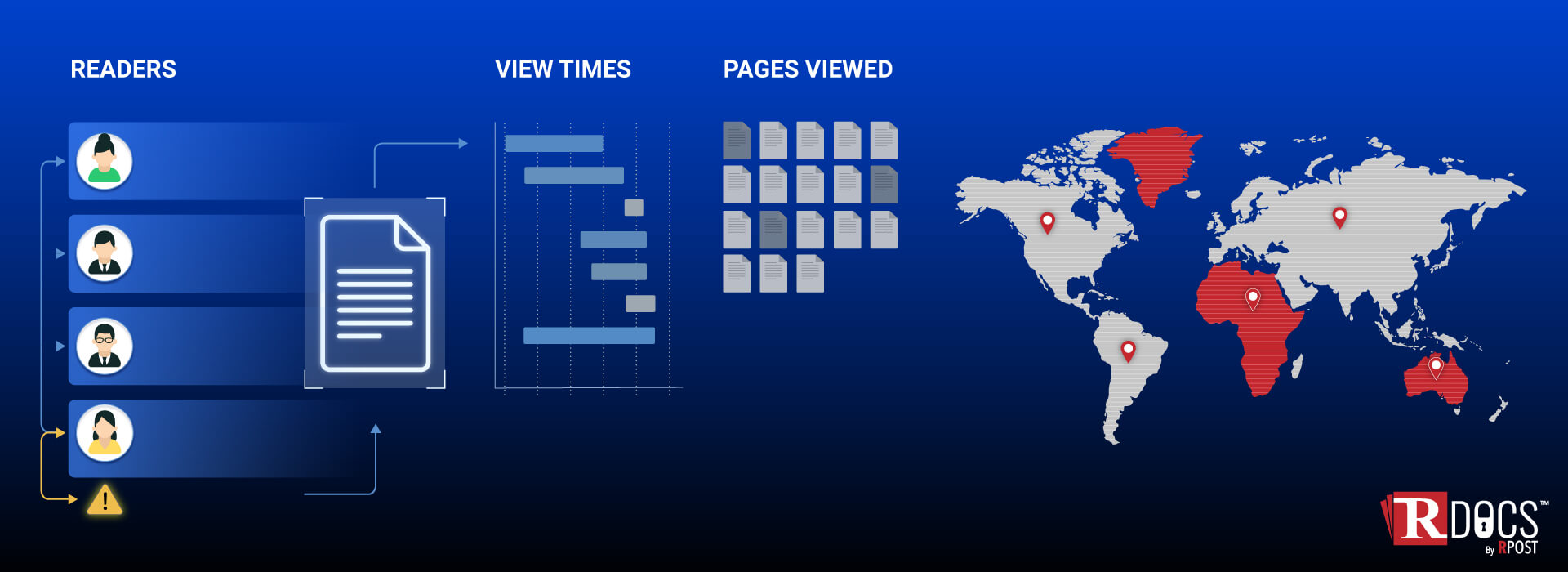
At the detection layer, every access event generates a timestamped, geolocated record that feeds the document's activity log in real time.
At the intervention layer, RAPTOR™ AI — RPost's AI-powered anomaly detection engine — monitors reading behavior against expected access patterns. When access deviates from that baseline, RAPTOR™ can automatically lock the document and alert the originator, who then makes an explicit decision to restore or permanently revoke access.
When an anomaly is confirmed and the originator issues a kill command, access is revoked across every copy of the document — including copies already downloaded to a recipient's local device. This is a technically significant distinction from server-side access control mechanisms, which lose reach once a file has been saved locally. In RDocs™, the control is embedded in the file, not in the server that served it.
A data privacy officer at a pharmaceutical company distributes a pre-publication clinical summary to a regulatory partner. The document is configured with domain restriction — accessible only from the partner's institutional domain — and geographic restriction limited to the partner's operating region.
Three weeks later, the activity log shows an access event from an IP outside the configured access zone, from a domain that does not match the authorized partner. RAPTOR™ AI flags the deviation, locks the document, and sends an alert. The data privacy officer reviews the event, identifies that the document was forwarded to an unauthorized party, and issues a permanent kill on all copies.
The incident is contained. The access log provides a complete timestamped record for regulatory purposes. Without document-level geofencing and automated anomaly detection, neither the deviation nor the forwarding would have been visible — and the clinical data would have remained in uncontrolled distribution.
Organizations that distribute sensitive documents externally and need demonstrable control over document access after delivery can explore how RDocs™ applies location-aware access controls and AI-powered anomaly detection to the document categories that carry the most risk.

October 13, 2026

September 01, 2026
August 13, 2026
July 10, 2026

July 03, 2026



 Blog
Blog