





Knowing that your document was opened is not the same as knowing that it was read.
For security-aware teams distributing sensitive documents to external parties — investors, regulators, opposing counsel, clinical partners, or deal counterparties — that distinction is where the real gap lies. A delivery confirmation or link-click notification tells you that someone interacted with a file at a specific moment. It tells you almost nothing about what they did with the content inside it, how long they spent on the sections that carry protected IP, whether those sections have since changed hands, and whether the person who opened it is actually the person you sent it to.
This is the intelligence gap between an "open" and a "read." For documents that carry financial projections, litigation strategy, clinical data, or proprietary technical architecture, the space between those two data points is where unauthorized disclosure most often begins — quietly, without an alert, long after the send.
In enterprise document security, access events and reading events tend to be treated as interchangeable. They are not.
An access event confirms that a file was opened from a specific IP address at a specific time. It tells you that an authorized — or unauthorized — session was initiated. A reading event captures what happened inside that session: which pages were viewed, how long each section held attention, whether the document was exited after the first page or consumed in full, and whether the same reader returned to specific sections a second or third time.
For low-risk documents, access events are reasonable audit data. For an M&A due diligence package, a clinical protocol summary, a pre-close deal agreement, or a pre-publication financial disclosure, the reading event is the data point that actually carries weight. Whether a reader spent 40 minutes on the technical IP section of a data room document or clicked a link and closed the file within seconds represents an entirely different risk posture — and in most organizations, both events look identical in the delivery log.
The risk is not just disclosure. It is undetected disclosure. A reader who methodically works through sensitive pages, notes key figures, and exits cleanly leaves no distinguishable trace in a system that only captures the open event.
Page Depth, Time Signals, and Re-Read Patterns
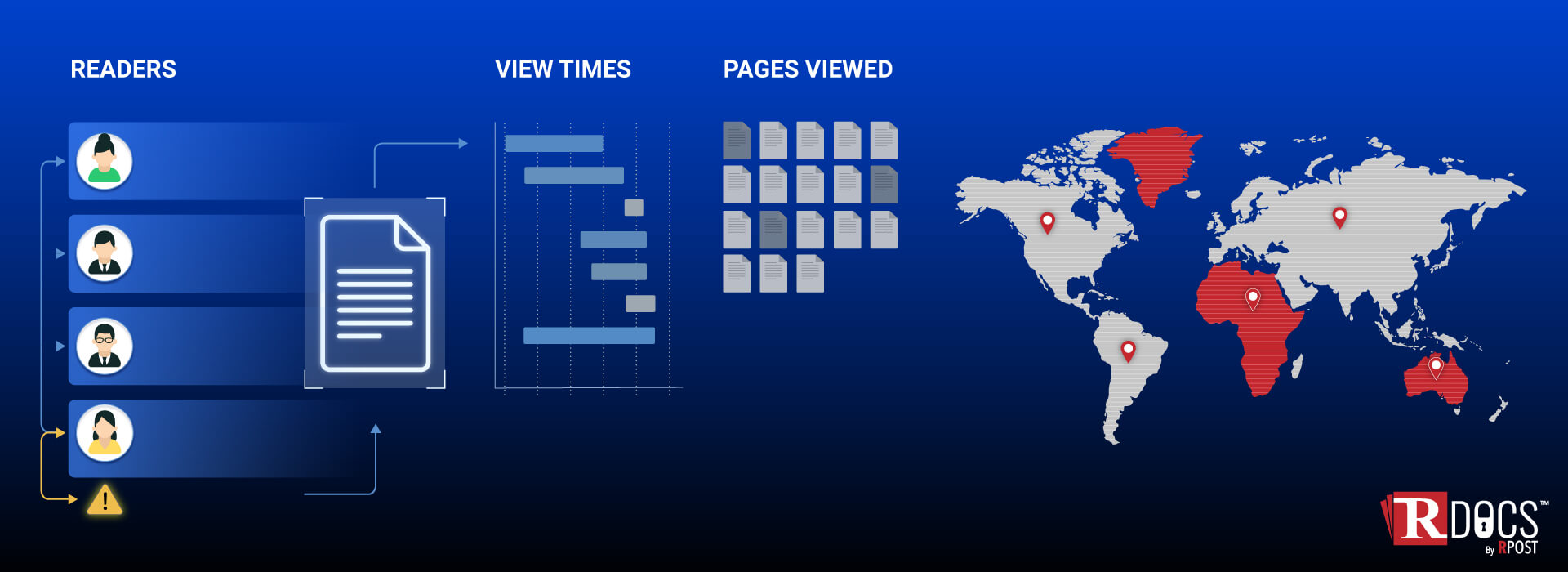
Reader-level viewing activity captures the behavioral layer of document engagement. This includes the sequence in which pages were visited, time spent per section relative to page length, whether specific pages were revisited, and how total reading time distributes across the document's structure.
For a CISO or compliance officer overseeing external distribution of sensitive IP, these signals matter in two concrete ways. First, they build an audit record that reflects not just access but actual engagement with protected content — a distinction that carries weight in regulated environments where demonstrating appropriate data stewardship requires more than a delivery log alone. Second, unusual reading patterns — a reader spending disproportionate time on a single appendix, or returning to a financial schedule on three separate occasions — can represent risk signals worth investigating before they escalate.
None of this intelligence is available from a system that logs only the open event.
The Forwarded Copy Problem: Tracking Readers Beyond the Original Recipient
The reading activity gap is compounded by one of the most common and least-discussed failure points in external document distribution: forwarding. When an authorized recipient forwards a file to a colleague, a counterpart, or an unauthorized third party, most document tracking systems lose the thread entirely. The forwarded copy exists outside the originator's visibility, opened by a reader who was never part of the original distribution.
This is a structurally different problem from the one addressed by location-based access controls. Geofencing and IP-range restrictions govern where a document can be read. They do not identify who reads a forwarded copy, for how long, or which sections they engaged with. Reader tracking that extends to forwarded copies requires that the tracking mechanism travel inside the document itself — persistent across channels, not anchored to the original delivery path.
When the tracking is file-embedded rather than tied to the sending channel, it can continue generating a reader activity log even after the document changes hands — capturing who opened the forwarded copy, when, and what their engagement looked like relative to the original authorized reader.
The Login Friction Trap in Enterprise DRM
The most common reason organizations settle for shallow document tracking is not a lack of awareness that deeper tracking exists. It is a practical problem created by how most enterprise digital rights management platforms handle reader authentication.
Conventional DRM approaches that provide per-reader activity logs typically require recipients to create an account, authenticate through a vendor portal, or install companion software before the document becomes accessible. In many high-stakes external distribution contexts, this creates an immediate and often fatal friction point.
An investor reviewing a pre-IPO financial model is not creating a third-party vendor account to open an attachment. An independent regulatory auditor accessing submitted compliance documentation is not installing software on a managed device to view a file. Outside counsel receiving a settlement demand package is not registering on a platform to open a PDF. In each of these scenarios, the friction destroys practical adoption before security can take meaningful effect. Organizations end up choosing between distributing sensitive documents with no reader-level visibility, or distributing through portal workflows that slow — and sometimes block — the business process they exist to support.
The login requirement in these scenarios is not a security strengthening. It is a security compromise that trades legitimate recipient inconvenience for reduced tracking adoption, producing the exact outcome organizations are trying to avoid: sensitive documents in circulation with no reliable reading record.
A well-designed secure document analytics layer should provide, at minimum: reader identity confirmed at the individual level without requiring account creation; time and duration of each reading session per named reader; which sections received sustained engagement; whether the file was forwarded and what the forwarded copy's reading activity generated; and how many times the same reader returned to the document across separate sessions. These metrics represent the difference between an access log and a reading record — and for regulated industries and IP-sensitive deal contexts, the reading record is the one with forensic value.
For CISOs and data privacy officers, per-reader viewing activity provides a chain of evidence that delivery logs cannot replicate. When a document containing protected IP, personal data, or material non-public information is later identified as the source of an unauthorized disclosure, a reading record allows investigators to identify which authorized reader accessed which sections, at what time, from which session. This is a materially different evidentiary starting point than an access log that confirms only that a link was clicked.
It also supports proactive policy enforcement. If an organization's document distribution policy requires that certain materials be reviewed only by named individuals through approved channels, per-reader tracking provides the audit layer to verify compliance with that policy without requiring recipients to use a separate system for every document type. The reading record becomes part of the governance framework around the document itself, not a separate platform requirement that breaks external distribution workflows.
Reader-level viewing activity serves a parallel function for business development executives and legal operations teams that operates entirely outside the traditional security use case. A deal team distributing a proposal to a prospective enterprise client gains direct intelligence when they are alerted in real time that the document is being reviewed — and specifically that the pricing and implementation sections are drawing sustained attention. That signal changes the cadence and content of follow-up in ways that delivery-only tracking cannot enable.
A business development executive who receives notification that a shared partnership framework has been opened and the financial structure section reviewed in depth has information that shapes when and how to initiate the follow-up conversation. In high-stakes deals where timing precision is the competitive differentiator, reading engagement data transforms the distributed document from a one-way transmission into a live intelligence asset.
RDocs™ authenticates each reader via their email address, generating a per-reader activity log that captures who read the document, when, the duration of each reading session, how many times a specific reader accessed the file, and the network and geographic context of each read. This reader-level data is visible to the document originator through a real-time dashboard — not surfaced in a weekly summary or periodic report, but available as events occur.
Critically, this tracking architecture extends to forwarded copies. If an authorized reader forwards the RPD™ file and a secondary reader opens it, that access and reading activity is also logged and associated with the new reader's session. The originator's visibility over the document's distribution chain does not break at the point of forwarding. The activity record follows the file.
Reader-level tracking identifies who read a document from a digital session perspective. Steganographic watermarking provides a complementary attribution layer that identifies whose authorized copy was the source of a potential leak — even when that leak does not occur through a digital channel.
Through a system RDocs™ refers to as Leakers Folly — detailed at Manage Content Sharing — each authorized reader's copy carries unique hidden markings. These are invisible to the reader during normal use, but forensically traceable if a screenshot, photograph, or printed copy of the document appears outside the authorized distribution. The hidden markings are uniquely linked to the specific authorized recipient whose copy was the source — providing court-admissible evidence of the disclosure path even in cases where the digital reading record shows nothing unusual.
Together, reading activity tracking and steganographic attribution create a document-level accountability layer that extends from the moment of opening through the full lifecycle of the content — including downstream disclosure through channels that no digital monitoring system can directly observe.
If your organization distributes sensitive documents externally and relies on access events as your primary visibility layer, exploring how RDocs™ structures per-reader activity tracking is a practical next step toward a more complete reading record.
September 01, 2026
August 13, 2026
July 10, 2026
July 03, 2026

June 26, 2026



 Blog
Blog